
Florida FLHSMV Permit Practice Test 4
Test 4 of 10. Pick an answer for each question to see if it is right and why; your score appears at the end. You need 40 correct answers to pass, the same ratio as the real Florida test.

- Questions50
- Correct to pass40
- Passing score80%
- Minimum age15 years
-
1. Someone has stepped into a marked crosswalk in the middle of a block ahead of you. What should you do?
Show answer
Answer A: Slow down, stop before the markings and let the person cross the street
A marked mid-block crosswalk carries the same duty as one at a corner: give way to the person crossing, stopping if that is what letting them cross safely takes.
-
2. How is a breach of the Florida driving hour restriction for a licensee under 18 charged?
Show answer
Answer B: As a moving violation
Driving outside the permitted hours without a qualifying supervisor or work trip is charged as a moving violation under chapter 318.
-
3. At an intersection that uses a lagging left turn, when is the left-turn arrow displayed?
Show answer
Answer B: After the through movement has run
A lagging left turn phase runs at the end of the green rather than the start, so a driver waiting to turn should not assume the arrow has been missed.
-
4. A yellow sign reading DEAD END is posted at the entrance to a street. What does it mean?
Show answer
Answer D: The street ends and there is no way through
A dead end street stops at its far end, so a driver who enters must come back out the same way.
-
5. Approaching the point this sign refers to, which hazard is most likely?
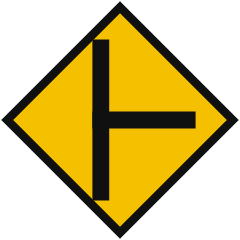
Show answer
Answer A: A vehicle pulling out from the entering road into the driver's path
The main risk is a driver on the entering road who misjudges the gap and pulls out, so covering the brake and being ready to slow is the sensible response.
-
6. You are stopped at a stop sign where your road ends at a two-way through street and you plan to turn left. What must you yield to?
Show answer
Answer B: Traffic from both directions and any pedestrians crossing
A left turn from the stem of a T crosses the near lane and joins the far one, so you give way to traffic in both directions and to pedestrians.
-
7. Low sun is shining onto the signal ahead and you cannot tell which light is lit. What should you do?
Show answer
Answer D: Slow down and be ready to stop until you can be sure
An unreadable signal has to be treated as one that may be red, so approach slowly enough to stop while you work out what it shows.
-
8. You will leave your vehicle for several hours after dark. Where is the best place to park it?
Show answer
Answer D: In a well-lit spot with people and cameras nearby
Light, passing people and cameras all discourage theft and make your own return to the vehicle safer.
-
9. You are approaching a narrow bridge where the road has one lane in each direction and no shoulder. What should you do about passing?
Show answer
Answer B: Do not pass on or near the bridge
A narrow bridge gives neither vehicle anywhere to go, so passing is prohibited there in the same way as on a hill or in a tunnel.
-
10. How many points does a Florida reckless driving conviction add to the driving record?
Show answer
Answer C: 4 points
Willful and wanton reckless driving is scored at four points on the Florida point schedule.
-
11. You are following another vehicle down a long, steep grade. What should you do about the gap?
Show answer
Answer D: Make it longer, because both of you need more room to stop
Everything takes longer to stop on a downgrade, including the vehicle ahead, so the gap that works on the flat is no longer enough.
-
12. Enhanced reference location markers differ from ordinary mileposts in that they
Show answer
Answer B: carry the route number and a mileage figure to the tenth of a mile
An enhanced reference location marker adds the route designation and carries the mileage to a tenth, so the point named is far more precise than a plain milepost.
-
13. You are pulling out of a farm entrance onto a rural highway. What is your obligation?
Show answer
Answer C: Yield to every vehicle already on the highway before you enter the roadway
A driver entering a highway from a private road or driveway yields to every vehicle already on the highway.
-
14. Which use of a wireless device does Florida expressly allow while driving?
Show answer
Answer B: Following turn-by-turn navigation on the device
The statute exempts navigation, safety alerts and vehicle-related data from the ban on manual entry and reading of interpersonal messages.
-
15. You find that the road surface has turned to sheet ice. What speed is appropriate?
Show answer
Answer A: A crawl, slow enough that you could stop without braking hard
Ice can cut grip to a fraction of normal, so stopping takes many times the usual distance and only a crawl leaves any margin.
-
16. On a street with parking along the curb, the shared lane marking is painted well out from the curb face. What does that placement tell a bicyclist?
Show answer
Answer C: To ride clear of the doors of parked cars
The marking is set at least eleven feet from the curb where parking is allowed so that riders are guided outside the reach of an opening door.
-
17. What does this sign require of the driver?
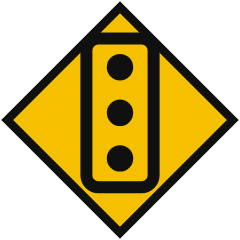
Show answer
Answer D: Reducing speed and being ready to stop at the intersection ahead
The advance notice asks the driver to slow and be ready to stop, while whether a stop is actually needed depends on the indication displayed on arrival.
-
18. In normal operation, which indication always comes between a green and a red on the same signal face?
Show answer
Answer C: A steady yellow
The yellow change interval must follow every green or green arrow, so a signal can never jump straight from green to red.
-
19. Besides emergency and work vehicles, which other vehicles does the Florida Move Over Law protect?
Show answer
Answer C: Disabled vehicles stopped with hazard lights, flares, signage or people visibly present
Florida extends the Move Over Law to disabled motor vehicles stopped with warning or hazard lights, emergency flares or signage, or where one or more people are visibly present.
-
20. A driver on the street this sign governs is preparing to turn left at the next corner. Which lane should the vehicle be in beforehand?
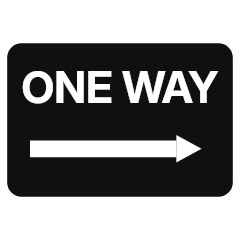
Show answer
Answer A: The lane closest to the left curb
All the traffic here runs the same way, so nothing is coming toward the driver and the turn is taken from the extreme left lane rather than from beside the middle of the roadway.
-
21. Traffic is entering the freeway from a ramp ahead of you and you are in the right lane. What should you do?
Show answer
Answer C: Move to another lane if it is safe, or adjust your speed to make room
Merging drivers may have little room to adjust. Helping them in by changing lanes or easing your speed prevents conflicts even though they must legally yield to you.
-
22. What must a driver be ready for beyond this sign?
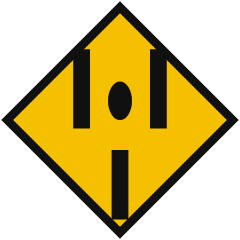
Show answer
Answer C: Vehicles approaching from the opposite direction in the next lane over
The separation between the two directions runs out, so from that point oncoming vehicles share the same pavement and the driver has to keep right.
-
23. What fine range applies to a first Florida DUI conviction where the blood or breath alcohol level was .15 or higher?
Show answer
Answer D: Not less than $1,000 and not more than $2,000
A level of .15 or higher raises the fine range for a first conviction to between $1,000 and $2,000, double the ordinary range.
-
24. You are on a country road with no sidewalk and two people are walking toward you on your side of the shoulder. What should you do?
Show answer
Answer C: Slow down and move over to give them room
Where there is no sidewalk, people are expected to walk on the shoulder facing traffic, and drivers must slow and give them space.
-
25. You began a turn from the wrong lane and are already inside the intersection. What should you not do?
Show answer
Answer A: Reverse in order to get back into the correct lane
Backing up in an intersection puts you into the path of traffic that cannot expect it; finish the movement and fix your position afterwards.
-
26. You are turning left into a street that is divided by a raised median. Which side should you enter?
Show answer
Answer C: The right-hand roadway, so that you travel on the proper side
A raised median separates two directions of travel, so the turn must be completed into the roadway carrying traffic your way.
-
27. You feel dizzy and get a headache while driving with the windows closed. What could be the cause and what should you do?
Show answer
Answer D: An exhaust leak letting carbon monoxide into the cabin, so open the windows and stop to get fresh air
Carbon monoxide is colorless and odorless, and headache, dizziness and drowsiness are early signs. Get fresh air at once and have the exhaust system inspected.
-
28. A pedestrian signal displays a steady walking person symbol. What does it mean for a pedestrian at that corner?
Show answer
Answer B: The pedestrian may start crossing in the direction of the signal
The steady walking person permits a pedestrian to begin the crossing, while still yielding to vehicles already lawfully in the intersection.
-
29. Why should you avoid swinging wide to the left before making a right turn in a car?
Show answer
Answer A: Another driver may think you are turning left and try to pass on your right
Swinging left first misleads other road users about your intention and invites someone to move up on your right, exactly where you are about to go.
-
30. A ball rolls into the street from between parked cars ahead of you. What should you expect and do?
Show answer
Answer A: Expect a child to follow it and be ready to stop
A ball is usually followed by a child who is watching the ball and not the traffic. Slow down and be prepared to stop immediately.
-
31. A 17-year-old Florida licensee may not drive between which hours unless accompanied by a licensed driver 21 or older?
Show answer
Answer C: 1 am and 5 am
A 17-year-old may not drive between 1 am and 5 am unless a licensed driver 21 or older is aboard or the trip is directly to or from work.
-
32. From which lane should a permitted U-turn be started?
Show answer
Answer A: The lane nearest the center line, the same one used for a left turn
A U-turn is begun from the far left lane for your direction, the same position used for a left turn, so you do not cut across traffic beside you.
-
33. Why is backing up on a freeway or on its shoulder prohibited?
Show answer
Answer A: Traffic arrives far too fast to expect a vehicle moving the wrong way
Freeway traffic closes on a stopped or reversing vehicle at highway speed and has almost no time to react to something moving against the flow.
-
34. On a Florida road where the posted maximum is 70 MPH, what is the minimum lawful speed?
Show answer
Answer C: 50 MPH
Where the maximum posted limit is 70 MPH, Florida raises the minimum speed to 50 MPH.
-
35. Once you have parallel parked, how close to the curb should your wheels be?
Show answer
Answer C: Within the distance your state allows, commonly 12 to 18 inches
Parking close to and parallel with the curb keeps the vehicle out of the traffic lane without damaging the tires; each state sets the exact maximum, usually 12 inches and 18 inches in some states.
-
36. Your lane is ending ahead in slow, heavy traffic and drivers in the next lane are already bumper to bumper. What is the recommended way to merge?
Show answer
Answer C: Take turns, one vehicle from each lane at the merge point
Alternating one for one at the merge point keeps both lanes moving and is the safest way to combine slow traffic.
-
37. May you exceed the posted speed limit in order to complete a pass?
Show answer
Answer C: No, the posted limit applies while you are passing too
The limit does not lift for passing; if you cannot complete the pass within it, there is not enough room and you should stay back.
-
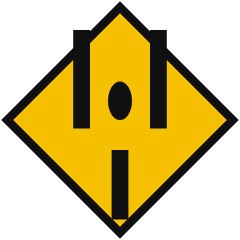
38. What change in the road does this sign announce?
Show answer
Answer B: The two directions of travel are about to be separated, and the driver must keep to the right of the separation
Ahead the roadway splits into separate one-way roadways on either side of a median, so the driver stays to the right of the divider and no longer meets oncoming vehicles.
-
39. Well before an intersection, an overhead sign shows a diagram of the lanes with an arrow above each one. What is its purpose?
Show answer
Answer C: To let drivers pick the correct lane in good time
Advance intersection lane control signs display the lane assignment far enough back that drivers can move over calmly instead of at the last moment.
-
40. Rain is falling and the outside temperature reads close to 32 degrees Fahrenheit. Why is that dangerous?
Show answer
Answer A: The rain can freeze on contact and glaze the road with ice
Near freezing, rain landing on cold pavement can turn to a glaze of ice almost at once, so a road that looks merely wet may have no grip at all.
-
41. You are already inside an intersection when you realize you should be in the lane beside you. What should you do?
Show answer
Answer C: Stay in your lane through the intersection and change lanes afterwards
Drivers in an intersection are watching for cross traffic and turning vehicles, so an unexpected sideways move there is easily missed.
-
42. You enter a work zone at night where one lane is closed and a flagger is on duty. What is the safest approach?
Show answer
Answer A: Slow early, merge before the closure and be ready to stop
Merging early at a reduced speed keeps the queue orderly and leaves you room to stop for equipment, workers or traffic that has halted ahead.
-
43. How long does a person cited for a Florida traffic infraction have to pay the civil penalty or ask for a hearing?
Show answer
Answer B: 30 days
A person who does not elect to appear must pay the civil penalty, and any delinquent fee, within 30 days of the citation or arrange a payment plan.
-
44. May you park across the entrance to a fire station?
Show answer
Answer D: No, an emergency exit must never be blocked
Emergency vehicles must be able to leave the moment a call comes in, so their entrances and exits are kept clear at all hours.
-
45. Four vehicles reach a four-way stop from all four directions at the same instant. How is the deadlock resolved?
Show answer
Answer C: Each driver yields to the vehicle on the right and they go one by one
Yielding to the right applies to every driver, so the group untangles itself as drivers take turns rather than moving together.
-
46. After a hardship reinstatement of a Florida license suspended under the point system, how long does the driver have to finish the required course?
Show answer
Answer B: 90 days
Florida requires proof of enrollment in the approved course before a hardship license is granted, and the course must be completed within 90 days after reinstatement or the license is cancelled.
-
47. Does Florida's school and work zone handheld ban apply to a vehicle that is not moving?
Show answer
Answer C: No, the ban does not apply to a motor vehicle that is stationary
The prohibition does not reach a motor vehicle that is stationary, so it targets handheld use while the vehicle is actually being driven.
-
48. You feel fine twenty minutes after your last drink. Why is that a poor guide to driving?
Show answer
Answer B: Your blood alcohol level can still be rising
Alcohol keeps being absorbed for some time after the last drink, so a driver who feels able at the door can be more impaired a few miles down the road.
-
49. You are turning left from a two-way street onto another two-way street. Where should you begin and end the turn?
Show answer
Answer B: Begin in the lane just right of the center line and finish just right of the center line of the new street
You approach a left turn from the lane closest to the center line and enter the new roadway just to the right of its center line, which keeps you clear of oncoming traffic.
-
50. What lighting must a bicycle used between sunset and sunrise carry in Florida?
Show answer
Answer B: A white front lamp visible 500 feet ahead and a red rear lamp or reflector visible 600 feet behind
Florida requires a bicycle ridden after dark to show a white lamp visible from 500 feet ahead and a red lamp or reflector visible from 600 feet behind.