
Florida FLHSMV Motorcycle Practice Test 16
- Questions50
- Correct to pass40
- Passing score80%
- Minimum age16 years
-
1. How is a violation of Florida's texting-while-driving law classified for a first and a second offense?
Show answer
Answer C: A nonmoving violation first, then a moving violation if repeated within five years
A first offense is a nonmoving violation; a second or subsequent offense within five years of the last one is punished as a moving violation.
-
2. When does Florida require headlights to be lit?
Show answer
Answer A: From sunset to sunrise, including twilight, and in rain, smoke or fog
Florida requires lighted lamps from sunset to sunrise, including the twilight hours, and during any rain, smoke or fog.
-
3. You must stop for a train at a highway-rail crossing. Where should you stop?
Show answer
Answer B: Behind the stop line, gate or signal and well clear of the nearest rail
Stop behind the stop line, gate or flashing-light signal and well clear of the nearest rail, because a train overhangs its track by several feet on each side.
-
4. A yellow diamond showing a bicycle is posted on a rural road. What should a driver expect?
Show answer
Answer A: Bicyclists crossing or riding along the roadway there
The bicycle warning sign is used where a bikeway crosses the road or where riders are likely to be in the traffic lanes, so drivers should look carefully and pass wide.
-
5. You are clear of the tracks after your vehicle stalled on a crossing. Whom should you contact?
Show answer
Answer C: The emergency number posted on the blue sign at the crossing, or 911
Grade crossings carry an emergency notification sign with a railroad phone number and a crossing identification number so that approaching trains can be stopped, and 911 works if that sign is not visible.
-
6. Under Florida's definition of a moped, the vehicle may not be capable of more than what speed on level ground?
Show answer
Answer C: 30 MPH
A moped has a motor of no more than 2 brake horsepower, cannot exceed 30 MPH on level ground and, if it has an internal combustion engine, no more than 50 cc.
-
7. The gates at a railroad crossing are down, and you can see that the road beyond them is clear. What is the correct action?
Show answer
Answer A: Wait until the gates rise completely and the lights go out
Lowered gates mean rail traffic is expected, and driving around them removes the only protection the crossing provides.
-
8. Why are motorcycles so often missed by other drivers?
Show answer
Answer C: Their narrow shape is easily hidden in traffic
A motorcycle presents a narrow outline that disappears behind pillars, mirrors and other vehicles, and it is harder to judge its speed and distance.
-
9. How long should a glance at a mirror or an instrument take?
Show answer
Answer A: A brief glance of about a second, returning your eyes to the road at once
Checks should be quick flicks of the eyes. At highway speed, a few seconds with your eyes off the road covers a distance long enough for a hazard to appear.
-
10. Your route crosses a long steel grid bridge deck. What should you do about braking and speed while you are on the grating?
Show answer
Answer B: Keep a steady speed and do any braking before the grating, not on it
A steel deck makes the motorcycle weave and offers less grip, so set your speed before you reach it, ride straight across, and brake on solid pavement.
-
11. A driver stopped on suspicion of impaired driving refuses to take a chemical test. What happens?
Show answer
Answer D: A license penalty follows for the refusal itself
Under implied consent, holding a license means agreeing to testing, so a refusal brings its own suspension separately from anything the court decides.
-
12. A deer has just crossed in front of you on a stretch signed for animal crossings. What is the best assumption?
Show answer
Answer B: More animals are likely to follow the first one
Deer travel in groups, so one animal crossing usually means others are about to follow, and a driver should slow and keep scanning both shoulders.
-
13. When should a rider use both brakes together?
Show answer
Answer D: Every time the motorcycle slows or stops
Using both brakes for every stop shortens stopping distance and builds the habit the rider will fall back on when a sudden stop is needed.
-
14. The lane you are in has a right-turn-only arrow painted on the pavement. What must you do?
Show answer
Answer C: Turn right, because a lane-use arrow is a legal requirement
Lane-use arrows painted on the pavement are regulatory markings, so a driver in that lane must travel in the direction shown.
-
15. A Florida driver under 21 is stopped with a breath alcohol level of .05. What extra condition applies before the license is reinstated?
Show answer
Answer C: Completion of a substance abuse course
For a driver under 21 whose level is .05 or higher, the suspension continues until a substance abuse course has been completed.
-
16. How does a rider judge whether the brake pads still have life left in them?
Show answer
Answer A: By looking at how much friction material is left on the pad
Pads are inspected visually for remaining thickness against the wear indicator, because a pad worn to its backing plate will destroy the disc.
-
17. The drive chain breaks or comes off while you are riding. What should you do first?
Show answer
Answer A: Close the throttle and brake to a stop clear of the roadway
A broken chain or belt takes the drive away at once, so the rider closes the throttle, slows under control with both brakes and stops well off the roadway.
-
18. What is the correct body position for riding over a bump or an obstacle?
Show answer
Answer B: Rise slightly off the seat with your weight on the footrests, absorbing the shock with knees and elbows
Coming slightly off the seat lets your legs and arms work as extra suspension instead of transferring the impact through your body and the handlebars.
-
19. How should a rider dress for a long ride in very hot weather?
Show answer
Answer C: In ventilated riding gear that still covers the arms and legs
Mesh and vented riding gear flows air while keeping its abrasion protection and shading the skin, so heat is not a reason to ride uncovered.
-
20. Why should riders avoid the center strip of the lane, especially where traffic stops often?
Show answer
Answer A: Because it collects oil and grease dripped from other vehicles
Drippings from other vehicles build up in the center of the lane, and the buildup is heaviest at busy intersections and toll booths where traffic sits waiting.
-
21. You are passing a line of slow traffic in the lane beside you and you notice a gap in that line ahead. What should you expect?
Show answer
Answer A: A vehicle may pull out of that gap into your lane
A gap in a slow line is an invitation to any driver waiting to turn out of a side street or to change lanes, and they are looking at the gap rather than at you.
-
22. What should you expect while driving through a parking lot?
Show answer
Answer D: Pedestrians and vehicles moving from any direction, so drive slowly
Parking lots mix walking people, reversing vehicles and poor sight lines, so low speed and constant scanning are the only reliable protection.
-
23. You are circulating in the inner lane of a two-lane roundabout, your exit is next, and a vehicle is beside you in the outer lane. What should you do?
Show answer
Answer C: Keep circulating around the island and take that same exit on your next time around
You may not cut across a vehicle in the outer lane; if you cannot exit safely, continue around the circle and try again.
-
24. How does alcohol change the time a driver needs to respond to a hazard?
Show answer
Answer A: It slows it, so stopping takes longer
Alcohol is a depressant that lengthens the time between seeing a hazard and acting on it, which adds directly to the distance needed to stop.
-
25. Two roads come together at a shallow angle under a MERGE sign, with no yield line on either one. What is expected of you?
Show answer
Answer D: Adjust your speed and position so you blend smoothly into the other traffic
A merge means neither road ends at a stop; drivers adjust speed and position so that the two streams fit together without stopping.
-
26. How can loose spokes be found on a spoked wheel?
Show answer
Answer B: By tapping each spoke and listening for a dull sound instead of a clear ring
A correctly tensioned spoke rings when tapped, while a loose one gives a flat, dull note that stands out from the rest of the wheel.
-
27. A pedestrian using a white cane or walking with a guide dog starts to cross the street ahead of you. What must you do?
Show answer
Answer A: Yield and stay stopped until the person has finished crossing
A white cane or guide dog identifies a pedestrian who may not be able to see your vehicle, so you must yield and wait rather than maneuver around the person. The horn can confuse the pedestrian or the dog.
-
28. Two vehicles meet on a steep, narrow mountain road with no room to pass. Which driver should back up?
Show answer
Answer C: The driver heading downhill, who has more control while reversing
On a narrow mountain road the vehicle facing downhill yields, because backing uphill gives better control than reversing down a grade.
-
29. An emergency vehicle is stopped on the shoulder ahead with its lights flashing. What does the move over principle require?
Show answer
Answer D: Change lanes away from it, or slow down if you cannot
Move over laws ask you to give responders an empty lane, and where traffic or a two-lane road makes that impossible, you slow down instead.
-
30. You are parked legally, but a police officer tells you to move the vehicle. What should you do?
Show answer
Answer B: Move it as directed, because an officer overrides the signs
Directions from a police officer or a firefighter take precedence over signs and markings, whether they are directing traffic or clearing a street.
-
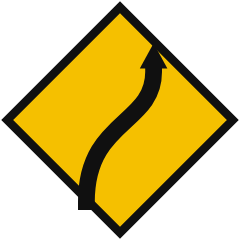
31. A driver holds a steady highway speed into the section this sign warns about. What is the most likely result?
Show answer
Answer B: The vehicle runs wide toward the outside and can cross into another lane or leave the pavement
Holding speed into a change of alignment asks the tires for more side grip than they can supply, so the vehicle runs wide and the driver is left with less room to correct.
-
32. You are first in the queue at a red light with a marked crosswalk. Where should your vehicle stop?
Show answer
Answer A: Behind the stop line, so that the crosswalk stays clear
Stopping short of the line keeps the crosswalk usable for people on foot and keeps your vehicle out of the path of turning traffic.
-
33. What does a light drag of the rear brake do during a slow, tight turn?
Show answer
Answer C: It steadies the motorcycle and smooths out the power reaching the rear wheel
Working the rear brake against a slipping clutch takes the jerkiness out of the drivetrain and holds the machine steady through the turn.
-
34. The throttle sticks open and will not close when you roll it back. What should you do?
Show answer
Answer B: Squeeze in the clutch and shut the engine down with the cut-off switch
Pulling in the clutch cuts power to the rear wheel immediately, and the cut-off switch stops the engine without the rider letting go of the handlebars.
-
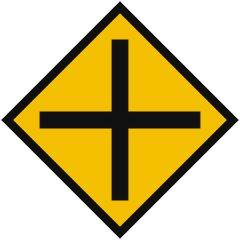
35. Does this sign settle who has the right-of-way at the intersection ahead?
Show answer
Answer D: No, it only gives notice of the intersection; the control there decides priority
A warning prepares the driver for what is coming but grants no priority, so whatever stop control, yield control, signal or right-of-way rule applies at the intersection is what decides.
-
36. Why do groups agree on a set of hand signals before setting off?
Show answer
Answer B: Because engine noise and helmets make speech useless between moving machines
Riders cannot talk to each other while moving, so agreed signals for hazards, stops, fuel and single file keep the whole group informed.
-
37. Which sequence describes a well-made turn?
Show answer
Answer A: Signal, move into the correct lane, slow down, check, then turn
Tell others first, take your position, lose the speed before the corner, take a final look, and only then steer through the turn.
-
38. Why is a pothole a bigger problem for a motorcycle than for a car?
Show answer
Answer C: A motorcycle has only two wheels, so an impact can deflect it off line
A car crosses a hole on four wheels and stays balanced, while a hole can knock a motorcycle off its line or damage a wheel, so scan the pavement well ahead and plan a path around holes.
-
39. A pedestrian near the curb is staring at a phone and not looking at traffic. What should you do?
Show answer
Answer A: Slow down and be ready to stop, because the pedestrian may step out without looking
Distracted pedestrians step into the street without checking. Assume they have not seen you and give yourself time and space to stop.
-
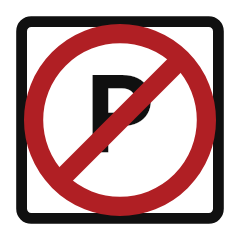
40. A driver leaves the vehicle at the curb where this sign is posted and walks away for two minutes. Is that allowed?
Show answer
Answer B: No, leaving the vehicle unattended there is prohibited whatever the length of the absence
Walking away leaves the vehicle parked, and the prohibition holds regardless of how long the driver is gone or whether the engine is left running.
-
41. You reach the end of the acceleration lane and there is still no gap in the traffic. What should you do?
Show answer
Answer B: Slow down and merge behind the traffic rather than forcing your way in
Merging behind the traffic costs you only a little speed, while forcing into a space that is not there puts you alongside a vehicle with nowhere to go.
-
42. Why is parking too close to a street corner prohibited?
Show answer
Answer D: Because it hides approaching traffic and pedestrians
A vehicle parked at a corner blocks the view that both drivers and pedestrians need before entering the intersection.
-
43. When must a motorcyclist in Florida have the headlight turned on?
Show answer
Answer D: At all times while operating on public streets or highways
Florida requires anyone operating a motorcycle on public streets or highways to have the headlight on while doing so, day or night.
-
44. Which use of a wireless device does Florida expressly allow while driving?
Show answer
Answer B: Following turn-by-turn navigation on the device
The statute exempts navigation, safety alerts and vehicle-related data from the ban on manual entry and reading of interpersonal messages.
-
45. What is the most common cause of rear-end collisions?
Show answer
Answer C: Following too closely to stop in time
A driver who leaves too little space has no room to perceive, react and brake when the vehicle ahead slows, which is why space management prevents rear-end crashes.
-
46. The lane control signal above your lane changes to a steady yellow X. What should you do?
Show answer
Answer A: Prepare to leave the lane, because it is about to be closed
A steady yellow X is the warning that the lane below it is about to close, giving drivers time to move over before the red X appears.
-
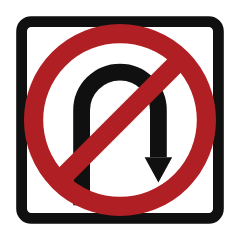
47. A driver who wants to reverse direction arrives at this sign. What is allowed?
Show answer
Answer C: Going on and reversing direction only where the maneuver is permitted
The restriction removes that maneuver at that spot entirely, so the driver has to continue and turn the vehicle around at a place where it is not prohibited.
-
48. You are overtaking in a short passing lane on a two-lane road and it is about to end. What must you do?
Show answer
Answer A: Finish the pass and move back to the right before it ends
The added lane ends and the traffic returns to a single lane in each direction, so the pass has to be complete before the pavement runs out.
-
49. Alcohol is classified as which kind of drug?
Show answer
Answer B: A depressant that slows the central nervous system
As a depressant, alcohol slows the brain and nervous system, which lengthens reaction time and dulls the coordination that driving depends on.
-
50. A driver is tailgating you. Why is it a bad idea to tap or stab the brakes to warn them?
Show answer
Answer C: Because it cuts the little space they have and can cause a crash
Brake checking removes the small margin the tailgater has left and can provoke a collision; add space in front of you instead and let them pass.