
Florida FLHSMV Permit Practice Test 27
- Questions50
- Correct to pass40
- Passing score80%
- Minimum age15 years
-
1. A Florida driver refuses a lawful test after a previous refusal suspension. How long is the new administrative suspension?
Show answer
Answer C: 18 months
A second or subsequent refusal brings an administrative suspension of 18 months, longer than the one-year suspension for a first refusal.
-
2. What happens to the fine for speeding in a Florida construction zone while workers or equipment are present?
Show answer
Answer C: It is doubled
Florida doubles the ordinary speeding fine for a violation in a construction zone where personnel are present or equipment is operating.
-
3. A strong wind is blowing across an open stretch of road. Besides the gusts, what else should you watch for?
Show answer
Answer A: Branches, dust and loose objects blown into your path
High wind strips branches, litter and dust onto the roadway and can push other vehicles out of their lane, so scan much further ahead than usual.
-
4. As a general rule, how far should you travel along a center two-way left-turn lane before you turn?
Show answer
Answer C: Only a short distance, just enough to slow down and wait for a gap
The center lane is for making or preparing a left turn, so you enter it only shortly before the turn and never travel along it as a through lane; several states set a specific limit such as 200 or 300 feet.
-
5. How should you position your vehicle for a right turn from a two-way street?
Show answer
Answer B: As close as practical to the right curb or edge, then turn into the nearest right lane
Right turns are made from the lane nearest the right edge into the nearest available lane, which keeps the turn tight and prevents a wide sweep into other traffic.
-
6. A center lane is marked with a broken yellow line on each side and is controlled by overhead lane signals. How is that lane used?
Show answer
Answer A: It carries traffic one way or the other according to the signals
A reversible lane is marked with broken yellow lines on both sides and its direction of travel is set by the lane control signals above it.
-
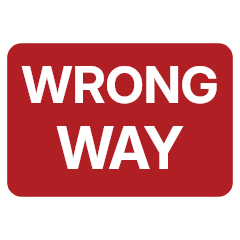
7. At a freeway exit ramp, this sign normally backs up which other regulatory sign posted nearer to the ramp terminal?
Show answer
Answer D: The sign that forbids entering that roadway at all
The two work as a pair at ramp terminals: one keeps drivers from turning in, and this one sits farther along to catch a driver who has already entered.
-
8. What happens to the driving privilege of a Florida minor found guilty of a drug offense under chapter 893?
Show answer
Answer B: It is revoked or withheld for 6 months
A court must direct the department to revoke or withhold the driving privilege of a person under 18 for six months on a chapter 893 drug offense, with a restricted license possible only in compelling circumstances.
-
9. After a first Florida DUI conviction with a blood alcohol level of .15 or higher, how long must an ignition interlock be installed?
Show answer
Answer A: At least 6 continuous months
A .15 or higher conviction, or one with a passenger under 18, requires an ignition interlock for at least 6 continuous months for a first offense and 2 years for a second.
-
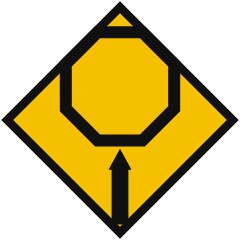
10. On a wet road, how should a driver adjust after passing this sign?
Show answer
Answer B: Start braking earlier, because a slippery surface lengthens the stopping distance
A wet surface lengthens stopping distance, so the extra warning distance should be spent braking gently and early instead of late and hard.
-
11. How is a violation of Florida's texting-while-driving law classified for a first and a second offense?
Show answer
Answer C: A nonmoving violation first, then a moving violation if repeated within five years
A first offense is a nonmoving violation; a second or subsequent offense within five years of the last one is punished as a moving violation.
-
12. You have a green light and are turning right while people are crossing the street you want to enter. Who goes first?
Show answer
Answer B: The pedestrians, and you wait until they are clear of your path
A green light permits the turn but does not remove the duty to yield to pedestrians already crossing the street you are turning into.
-
13. The traffic around you is moving well above the limit on a wide highway. What should you do?
Show answer
Answer D: Keep to the limit and stay to the right, letting faster traffic pass
The limit is a legal maximum, and the safe way to differ from the traffic around you is to keep right and let it go by.
-
14. You have begun to move into the next lane when the gap you were aiming for closes. What is the safest action?
Show answer
Answer C: Return to your own lane, cancel the signal and wait for a better gap
An unfinished lane change leaves you in a space that no longer exists, and the lane you came from is still yours.
-
15. You are already inside an intersection when you realize you should be in the lane beside you. What should you do?
Show answer
Answer C: Stay in your lane through the intersection and change lanes afterwards
Drivers in an intersection are watching for cross traffic and turning vehicles, so an unexpected sideways move there is easily missed.
-
16. The driver of a slow farm vehicle moves partly onto the shoulder and waves you past. Who is responsible for the pass?
Show answer
Answer A: You are, so pass only if you can see that the road is clear
A courtesy wave is not a traffic control, and the driver who changes lanes is the one answerable for the maneuver.
-
17. A sign with a blue background and a white legend and border tells road users about
Show answer
Answer A: services such as fuel, food, lodging, hospitals and rest areas
Blue is the background of the general service series, which points travelers toward the services available along or near the route.
-
18. The light ahead is green but traffic beyond the intersection is backed up. What should you do?
Show answer
Answer B: Wait behind the intersection until there is room to clear it completely
You may not enter an intersection unless you can get completely through it, because stopping inside blocks cross traffic when the signal changes.
-
19. How far ahead should you normally be looking as you drive?
Show answer
Answer C: About 12 to 15 seconds ahead, well beyond the vehicle in front
Looking that far down the road lets you see a problem developing and slow smoothly, instead of discovering it in time only for hard braking.
-
20. A large truck is passing you on a two-lane road. What is the safest thing to do?
Show answer
Answer C: Keep right in your lane and ease off the gas a little
Staying in your own lane and easing off shortens the pass without forcing you onto a soft shoulder or into the truck's path.
-
21. Why should cruise control be switched off on wet, snowy or icy roads?
Show answer
Answer B: It may keep feeding power to a wheel that has started to slip, and cancelling it costs you time
Cruise control holds a set speed regardless of grip, so it can add power just as a tire loses traction, and the extra step of cancelling it delays your response.
-
22. You are stopped at an intersection where bushes block your view of cross traffic. What should you do?
Show answer
Answer A: Edge forward slowly until you can see, then proceed when clear
Creeping forward a little at a time lets you gain a view without committing to the crossing. Never enter an intersection you cannot see into.
-
23. A large X with the letters R and R beside it is painted across your lane. What does it mean?
Show answer
Answer A: A railroad crossing lies a short distance ahead
The pavement marking repeats the advance warning for a grade crossing, and it is used on paved approaches where speeds are high or where gates are installed.
-
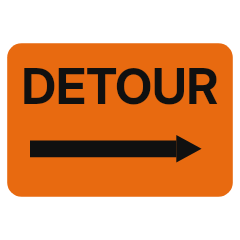
24. Which of these is true of the roadway a driver is being sent onto here?
Show answer
Answer D: Its own signs, signals and speed limits govern for the whole way around
The alternate route is an ordinary public road, so every control posted on it governs as usual; being sent that way grants no extra priority and no relief from the limits in force there.
-
25. A yellow lamp flashes above a warning sign at a sharp curve. What does it ask of a driver?
Show answer
Answer D: Slow down and pass the point with extra care
A warning beacon draws attention to the sign it is mounted with, and the message of the sign is what the driver must act on.
-
26. How should the outside mirrors be aimed to reduce your blind spots?
Show answer
Answer A: Outward, so each one covers the lane beside you rather than repeating the inside mirror
Mirrors aimed too far inward show you the same road three times and leave a large gap beside the vehicle, so aiming them outward shrinks the blind spot.
-
27. A sign warns that your exit leaves from the left side of the freeway. What should you do?
Show answer
Answer D: Move into the left lane in good time before you reach the exit
Left-hand exits are unusual, which is exactly why they are signed well in advance and why the lane changes should be finished early.
-
28. Two solid white lines separate your lane from the lane beside it. What do they mean?
Show answer
Answer B: Crossing from one lane to the other is prohibited
A solid double white line marks a boundary that road users may not cross, such as the entrance to a preferential lane.
-
29. You are driving through a residential area where parked cars hide the side streets. What is the safest approach?
Show answer
Answer C: Slow down and cover the brake as you pass each opening
Where parked vehicles hide side streets and driveways, lower speed and a covered brake buy the time you lose in sight distance.
-
30. You must cross a stretch of water lying across the road that you know is shallow. What is the right technique?
Show answer
Answer A: Slow down before you reach it and cross steadily in a low gear
Slow before the water, then keep a steady low speed so you do not throw water over the engine or lose steering. Test the brakes gently once you are through.
-
31. What is the driver expected to do after passing this sign?
Show answer
Answer A: Begin slowing so that a complete stop can be made at the intersection ahead
It is used where the control at the intersection stays hidden until late, so braking should begin here rather than at the stop line.
-
32. The divided highway ends warning sign means that
Show answer
Answer D: the median separating the directions ends and the road returns to two-way operation
Beyond this sign opposing traffic is no longer separated by a median, so the driver must keep right and expect vehicles approaching in the adjacent lane.
-
33. You are in a minor collision on a busy road. No one is hurt and both vehicles can be driven. What is the recommended thing to do?
Show answer
Answer C: Move the vehicles out of the travel lanes to a safe spot before exchanging information
Vehicles left in traffic after a minor crash invite a second, often worse, collision. Clearing the lane protects everyone, and you still exchange details and report as required.
-
34. A raised area crosses the roadway and carries a series of white markings on its face. What are those markings for?
Show answer
Answer A: To make the hump visible so drivers slow for it
Speed hump markings warn drivers that the pavement rises, which matters most at night or when the hump is in shadow.
-
35. Does using a hands free device remove the risk of distraction?
Show answer
Answer A: No, the conversation still takes attention away from driving
Hands free equipment removes the manual part of the distraction but not the mental part, and a driver deep in conversation can look straight at a hazard without registering it.
-
36. You make eye contact with a driver waiting to pull out of a side street. What should you assume?
Show answer
Answer D: The driver may still not have seen you, so stay ready to slow or stop
Drivers can look directly at you and still not register your vehicle, especially a small one. Eye contact helps, but never rely on it.
-
37. What does black ice usually look like from the driver seat?
Show answer
Answer C: A patch of pavement that simply looks wet or slightly glossy
Black ice is clear, so you see the dark road through it and read it as a wet patch. In freezing weather, treat any wet looking patch as ice.
-
38. When must a nonresident whose vehicle stays in Florida maintain the required insurance security?
Show answer
Answer D: Once the vehicle has been in Florida for more than 90 days in 365
A nonresident owner whose vehicle is physically present in Florida for more than 90 days out of any 365 must maintain the required security.
-
39. You are descending a long steep grade with a loaded truck close behind you. What should you do?
Show answer
Answer A: Hold a steady speed and let it pass when it can
Gravity pushes a loaded truck downhill and it cannot slow quickly, so give it a predictable speed and room to get by rather than braking in front of it.
-
40. How should you use your mirrors while another vehicle overtakes you on a multilane road?
Show answer
Answer C: Follow it from the inside mirror to the side mirror and then to your own view
Handing the vehicle from one mirror to the next keeps it in sight through the blind spot instead of losing it there.
-
41. You are slowing to turn right at an intersection and a bicyclist is riding beside your right side in a bike lane. What should you do?
Show answer
Answer D: Let the bicyclist go through the intersection before you begin the turn
Turning across the path of a bicyclist who is going straight causes the classic right-hook crash. The rider continuing straight has the right-of-way over your turn.
-
42. What does a booster seat do for a child?
Show answer
Answer B: It lifts the child so that the adult belt crosses hips and shoulder
A booster raises the child so the adult belt lies on the strong parts of the body instead of the neck and the abdomen.
-
43. What is the recommended minimum distance between the driver's breastbone and the center of the steering wheel air bag cover?
Show answer
Answer C: About 10 inches
An air bag inflates extremely fast, and keeping that much space lets it deploy fully before it reaches the driver, which is why the seat should be moved back as far as still allows comfortable control of the pedals.
-
44. Why should you set the parking brake even when an automatic transmission is in Park?
Show answer
Answer B: Because it takes the strain off the transmission and holds the vehicle
The parking pawl is a small part carrying the whole vehicle; the parking brake shares that load and holds the vehicle if the pawl fails.
-
45. What is the minimum length of a Florida traffic law and substance abuse education course?
Show answer
Answer A: 4 hours of content, minus up to 30 minutes for breaks
Traffic law and substance abuse education courses must devote a minimum of 4 hours to course content, minus a maximum of 30 minutes allotted for breaks.
-
46. May a Florida driver show proof of insurance on a phone, and what does that mean for the officer?
Show answer
Answer B: Yes, and showing the device is not consent to view anything else on it
Florida accepts an electronic display of proof of insurance, and presenting the device does not constitute consent for the officer to access other information on it.
-
47. A small plate under a stop sign reads CROSS TRAFFIC DOES NOT STOP. What is it telling you?
Show answer
Answer D: Traffic on the cross street is not required to stop at all
The plate warns that the other road is uncontrolled, so you must wait for a gap instead of expecting anyone to take turns with you.
-
48. You are on a two-lane road where a broken yellow line runs on your side of the center. What does that pattern allow?
Show answer
Answer C: Passing when the way ahead is clear and it is otherwise legal
A broken yellow center line marks a stretch where passing is permitted for traffic on that side when it can be completed safely.
-
49. As speed rises, which part of the total stopping distance grows the fastest?
Show answer
Answer B: The braking distance, which grows far faster than speed itself
Perception and reaction distances grow in step with speed, but braking distance grows roughly with the square of speed, so it dominates at higher speeds.
-
50. What does Florida require to operate a low-speed vehicle on a public street?
Show answer
Answer A: It must be registered, insured and titled, and the driver must hold a valid license
A low-speed vehicle must be registered and insured under section 320.02, titled under chapter 319, and anyone operating it must have a valid driver license.