
Florida FLHSMV Permit Practice Test 25
- Questions50
- Correct to pass40
- Passing score80%
- Minimum age15 years
-
1. Enhanced reference location markers differ from ordinary mileposts in that they
Show answer
Answer B: carry the route number and a mileage figure to the tenth of a mile
An enhanced reference location marker adds the route designation and carries the mileage to a tenth, so the point named is far more precise than a plain milepost.
-
2. How should a lap and shoulder belt be positioned?
Show answer
Answer A: Lap belt low across the hips and shoulder belt across the chest and collarbone
The lap belt must bear against the strong pelvic bones rather than soft organs, and the shoulder belt must cross the rib cage and collarbone so crash forces spread over the skeleton.
-
3. An officer directing traffic faces you and holds one hand up with the open palm toward your vehicle. What does the gesture mean?
Show answer
Answer D: Stop before reaching the officer
A raised open palm shown toward a driver is the standard signal to stop.
-
4. The only person offering you a ride home has been drinking. What should you do?
Show answer
Answer B: Do not get in; find another way home
A passenger in an impaired driver's vehicle shares all of the risk and can do nothing about it from the seat, so the only safe answer is another ride.
-
5. What should you do about snow and ice on your vehicle before driving?
Show answer
Answer C: Clear all glass, mirrors and lights, and the roof and hood as well
Snow left on the roof or hood slides onto your windshield when you brake and blows into the path of drivers behind you, and covered lights make your vehicle hard to see.
-
6. In plain words, what is understeer?
Show answer
Answer B: The vehicle keeps going straight even though the wheels are turned
Understeer means the front tires have run out of grip, so the vehicle takes a wider line than the one you steered.
-
7. A yellow diamond shows an arrow that doubles back on itself. What kind of curve lies ahead?
Show answer
Answer C: A turn of 135 degrees or more, nearly doubling back
The hairpin curve sign is used where the road changes direction by 135 degrees or more, and it is normally backed up by chevrons or a large arrow through the bend.
-
8. Besides emergency vehicles, which working vehicles does Florida's Move Over Act protect when they are stopped on the roadside?
Show answer
Answer C: Sanitation vehicles and utility service vehicles
The Act names sanitation vehicles and utility service vehicles alongside emergency vehicles, wreckers and maintenance vehicles.
-
9. You are approaching the entry of a modern roundabout. Who must you yield to?
Show answer
Answer C: Traffic already circulating in the roundabout, which approaches from your left
Traffic in a United States roundabout circulates counterclockwise, so drivers entering must look left and yield to vehicles already in the circulating roadway.
-
10. The stability control warning light flashes while you are driving through a curve. What does it mean?
Show answer
Answer A: The system is actively working to keep the vehicle under control, so slow down
A flashing stability control light means the system is braking individual wheels because you are near the limit of grip. Ease off and drive more gently.
-
11. What do the grooves in a tire tread do on a flooded road surface?
Show answer
Answer B: They give the water a way to escape so the tread can touch the road
Tread grooves pump water out from under the tire so rubber can meet pavement. A worn tread moves less water, so hydroplaning starts sooner.
-
12. A train has just cleared a crossing that carries two sets of tracks. What should you do?
Show answer
Answer B: Wait and look both ways for a second train
A passing train hides a second train on the other track, so wait until the signals stop and you can see that both tracks are clear.
-
13. Is it acceptable to leave your vehicle across the entrance of an alley for a short time?
Show answer
Answer A: No, the entrance must stay clear at all times
Blocking an alley entrance traps the vehicles inside and can keep emergency services out, so it is prohibited however brief the stop.
-
14. What relief does Florida offer a first-time violator of the school and work zone handheld ban?
Show answer
Answer C: Dismissal on proof of purchase of hands-free equipment for the vehicle
A first-time violator may have the charge dismissed and court costs waived on showing proof of purchase of equipment allowing hands-free use, or by completing an approved safety programme.
-
15. On a two-way street, where and how should you park at the curb?
Show answer
Answer C: On the right side, facing the way traffic moves
On a two-way street you must park on the right, headed in the direction of travel; parking facing traffic is prohibited.
-
16. A single solid white line separates two lanes running in the same direction. What is it telling drivers?
Show answer
Answer A: Changing lanes there is discouraged
A solid white lane line discourages lane changing, typically where merging or weaving would create a hazard.
-
17. On a long, straight highway you feel your attention fading. What helps you stay alert?
Show answer
Answer A: Keep your eyes moving, scan mirrors and signs, and take regular breaks
Staring at one point brings on highway hypnosis. Active scanning keeps the mind engaged, and a break every couple of hours restores alertness.
-
18. What is the correct technique for backing a vehicle straight?
Show answer
Answer B: Check behind the vehicle before getting in, then turn and look through the rear window while backing slowly
Mirrors and cameras leave gaps close to the vehicle, so walk behind it first, then turn in your seat for a direct view and keep the speed low enough to stop instantly.
-
19. In Florida, how close to a crosswalk at an intersection may you stand or park?
Show answer
Answer A: No closer than 20 feet
Standing or parking is prohibited within 20 feet of a crosswalk at an intersection.
-
20. How long is the suspension when a Florida driver under 21 refuses a lawful breath test for the first time?
Show answer
Answer A: 1 year
A first refusal by a driver under 21 brings a one-year suspension, twice the six-month suspension for a first violation of the .02 rule.
-
21. On a busy multilane highway, where is the best place to travel?
Show answer
Answer B: In a gap in the traffic, with space open on both sides
Travelling in a gap keeps escape routes open on both sides, while riding alongside other vehicles removes the room you would need to swerve.
-
22. A person using a wheelchair is waiting to cross at a corner ahead. How should you treat that person?
Show answer
Answer B: As a pedestrian with the right of way at the crossing
A wheelchair or a mobility scooter user has the rights of a pedestrian, so yield the whole crossing and wait until the crossing is finished.
-
23. A police officer is directing traffic at an intersection and waves you through a red light. What should you do?
Show answer
Answer C: Follow the officer, whose directions come before signs and signals
Directions given by a police officer or an authorized flagger override signs, signals and pavement markings.
-
24. What is a microsleep?
Show answer
Answer D: A few seconds of sleep, sometimes with the eyes open
A microsleep is an involuntary lapse of a few seconds during which the driver is asleep and the vehicle travels blind, often without the driver knowing.
-
25. Your green left-turn arrow goes out and a steady green ball stays lit. What may you do?
Show answer
Answer A: Continue turning left, but only after yielding to oncoming traffic
When the arrow ends and a green ball remains, the turn changes from protected to permissive, so it is still allowed but oncoming traffic goes first.
-
26. Some toll facilities use signs and markings with a purple background or a purple stripe. What do they identify?
Show answer
Answer D: Lanes reserved for vehicles with an electronic toll account
Purple is assigned to lanes and ramps restricted to vehicles with a registered electronic toll collection account, so drivers without one must stay out.
-
27. When are the hazard warning lights properly used?
Show answer
Answer A: When your vehicle is stopped or barely moving and is a hazard
Hazard lights warn that your vehicle is an obstruction; they do not authorize illegal parking and they hide your turn signals while driving.
-
28. You are turning right from a one-way street onto a two-way street. Where should the turn end?
Show answer
Answer A: In the lane nearest the right curb of the street you are entering
A right turn starts and finishes as close to the right as practical, so you leave the one-way street from the right lane and arrive in the lane nearest the right curb.
-
29. At a stop sign with a painted stop line and a crosswalk, where must you stop?
Show answer
Answer D: At the stop line, before it and before the crosswalk
You stop at the stop line first, and only if there is no stop line do you stop before the crosswalk, and only if there is neither do you stop before entering the intersection.
-
30. How many points does Florida assess for unlawful speed of more than 15 MPH over the lawful or posted limit?
Show answer
Answer B: 4 points
Florida separates speeding into bands and assesses four points when the speed is more than 15 MPH above the lawful or posted limit.
-
31. What may be used for a 4 or 5 year old child in Florida?
Show answer
Answer C: A separate carrier, an integrated child seat or a child booster seat
For children aged 4 through 5, a separate carrier, an integrated child seat or a booster seat may be used. A safety belt alone is allowed only in narrow cases.
-
32. What most often starts a rear wheel skid?
Show answer
Answer A: Too much speed, braking or acceleration for the grip available
A skid begins when what you ask of the tires exceeds what the surface can give, which is usually a matter of speed and of how abruptly you use the controls.
-
33. Does this sign settle who has the right-of-way at the intersection ahead?
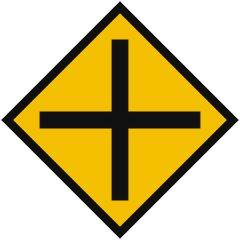
Show answer
Answer D: No, it only gives notice of the intersection; the control there decides priority
A warning prepares the driver for what is coming but grants no priority, so whatever stop control, yield control, signal or right-of-way rule applies at the intersection is what decides.
-
34. You pull onto a soft grass verge to park. What is the main risk?
Show answer
Answer A: The wheels can sink and the car can slide toward the ditch
Soft ground gives way under the weight of a vehicle, and a car that settles or slides sideways can end up stuck or in the ditch.
-
35. Why is it dangerous to make a left turn from the second lane from the center?
Show answer
Answer C: Because a driver in the lane beside you is turning into the same space
Drivers in the proper turn lane are entitled to that space, and turning across them puts two vehicles into one path through the intersection.
-
36. What are front fog lights for?
Show answer
Answer D: Adding a low, wide beam close to the car when visibility is poor
Fog lights throw a low, wide beam under the fog, which is why they are mounted low and are used only in poor visibility.
-
37. What is the position of a Florida vehicle owner who has no required security in force at the time of a crash?
Show answer
Answer B: The owner is personally liable for the benefits the policy would have paid
An owner without security at the time of a crash loses immunity from tort liability and becomes personally liable for the payment of benefits.
-
38. What is the most common cause of rear-end collisions?
Show answer
Answer C: Following too closely to stop in time
A driver who leaves too little space has no room to perceive, react and brake when the vehicle ahead slows, which is why space management prevents rear-end crashes.
-
39. How many points does a Florida officer-issued citation for running a red light carry?
Show answer
Answer B: 4 points
A traffic control signal violation carries 4 points, but no points are imposed when the violation is enforced by a traffic infraction enforcement officer using cameras.
-
40. How can you tell that a child safety seat is installed tightly enough?
Show answer
Answer C: It moves less than an inch side to side or front to back at the belt path
A correctly installed seat is nearly immovable where the belt or lower anchors pass through it. Excess movement lets the child's body travel farther in a crash.
-
41. Why should you not switch the engine off while the vehicle is still moving fast?
Show answer
Answer B: You lose power steering and the steering may lock
With the engine off the steering becomes very heavy and on many vehicles the column can lock, so shift to neutral first and only shut down once stopped.
-
42. A driver passes this sign on an entrance ramp while merging onto a freeway. Who has priority?
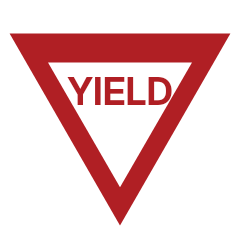
Show answer
Answer B: The traffic already traveling on the freeway
The sign places the duty on the entering driver, who must adjust speed and fit into a gap without forcing through traffic to brake or swerve.
-
43. A nonresident takes a job in Florida and drives here. How soon must he or she get a Florida driver license?
Show answer
Answer C: Within 30 days after starting the job
A nonresident who accepts employment, engages in a trade or enrolls children in public school must obtain a Florida license within 30 days if driving here, with exceptions such as migrant farm workers.
-
44. A driver is tailgating you. Why is it a bad idea to tap or stab the brakes to warn them?
Show answer
Answer C: Because it cuts the little space they have and can cause a crash
Brake checking removes the small margin the tailgater has left and can provoke a collision; add space in front of you instead and let them pass.
-
45. You have finished parallel parking at the curb. How should the vehicle sit?
Show answer
Answer A: Close to the curb, so that it does not stick out into the traffic lane
A parked vehicle must sit close enough to the curb that it does not intrude into the path of passing traffic; the exact maximum distance is set by each state.
-
46. You are approaching a sharp curve. When should you reduce your speed?
Show answer
Answer D: Before you enter the curve, so you can accelerate gently through it
Braking hard inside a curve uses up the traction that is already being demanded for cornering, so the slowing must be finished before you enter.
-
47. You are backing out of a home driveway onto a street with a sidewalk. Who must you yield to?
Show answer
Answer D: All traffic on the street and everyone on the sidewalk
A driver entering the roadway from private property yields to everyone already using the sidewalk and the street.
-
48. You began a turn from the wrong lane and are already inside the intersection. What should you not do?
Show answer
Answer A: Reverse in order to get back into the correct lane
Backing up in an intersection puts you into the path of traffic that cannot expect it; finish the movement and fix your position afterwards.
-
49. You are traveling beside another vehicle on a multilane highway at nearly the same speed. Why is this a poor position?
Show answer
Answer B: You may be sitting in that driver's blind spot with nowhere to go if they move over
Driving alongside removes your side escape route and often puts you where the other driver cannot see you. Speed up or drop back to open space beside you.
-
50. What should you check on the hitch before towing a trailer?
Show answer
Answer B: That the coupler is locked and the safety chains are crossed underneath
The coupler must be latched and pinned, and the chains crossed under the tongue so they cradle it if the coupling lets go.