
Florida FLHSMV Permit Practice Test 12
- Questions50
- Correct to pass40
- Passing score80%
- Minimum age15 years
-
1. For how long must a Florida driver keep the higher liability limits imposed after a DUI conviction?
Show answer
Answer C: 3 years
The higher limits must be maintained for a minimum of three years, after which a driver with no further DUI or felony traffic convictions becomes exempt.
-
2. A yellow pennant, an isosceles triangle with its long axis horizontal, is reserved for which message?
Show answer
Answer D: No passing zone
The pennant shape is used only for the no passing zone sign, which marks the point where overtaking is no longer allowed.
-
3. Does a Florida driver need a motorcycle endorsement to operate an autocycle?
Show answer
Answer B: No, no motorcycle endorsement is needed
Florida requires a license that authorizes motorcycle operation, but the same section states that an autocycle may be operated without a motorcycle endorsement.
-
4. You are turning left from a divided highway through a median opening into a business on the other side. Who has the right of way?
Show answer
Answer C: The traffic on the roadway you are crossing
Turning through a median opening means crossing the opposite roadway, so you yield to all traffic on it before you go.
-
5. You are waiting to turn left and an oncoming vehicle stopped in the near lane to turn left blocks your view of the far lane. What should you do?
Show answer
Answer A: Wait where you are until you can see that the far lane is completely clear
The lane you cannot see is where the crash comes from, so you hold your position until the view opens up.
-
6. A turn restriction sign at the corner shows a range of times below the symbol. What does that mean?
Show answer
Answer A: The turn is banned only during the hours shown on the sign
Times posted under a regulatory symbol set the period during which the restriction applies; outside those hours the movement is permitted.
-
7. How does marijuana affect a driver?
Show answer
Answer C: It slows reaction time and impairs judgment of time and distance
Marijuana impairs coordination, attention and the ability to judge speed and distance. Driving while impaired by it is illegal everywhere, even where its use is legal.
-
8. You are approaching a traffic light that has been green for a long time. How should you treat it?
Show answer
Answer C: Expect it to change and be ready to stop
A light that has been green for a while is called a stale green light. Cover the brake and decide in advance where you could still stop safely.
-
9. A broken white line separates your lane from the lane beside it. What does it indicate?
Show answer
Answer C: Both lanes carry traffic in the same direction and lane changes are permitted
White lines separate lanes of traffic moving in the same direction, and a broken white line means changing lanes across it is permitted when it is safe.
-
10. A yellow diamond shows an arrow bent into a series of reversing turns. What does it warn about?
Show answer
Answer A: Three or more changes of direction close together
The winding road sign replaces a string of separate curve signs where several bends follow one another with only short straights between them.
-
11. When is a Florida school zone speed limit actually in force?
Show answer
Answer D: For 30 minutes before, during, and 30 minutes after arrival and dismissal
The reduced limit applies only in the window running from half an hour before arrival, through the arrival or dismissal period, to half an hour afterwards.
-
12. Yellow signs each showing one large black arrowhead, installed in a row along the outside of a curve, are
Show answer
Answer D: chevron alignment signs marking the change of direction of the curve
Chevron alignment signs are placed on the outside of a curve so that several are in view at once, letting the driver judge how sharply the road turns.
-
13. How should your speed behave while you move from one lane into the next?
Show answer
Answer C: Keep it steady or adjust it smoothly to match the traffic in the new lane
A lane change works best as a smooth movement at the speed of the lane you are joining, since sudden braking or acceleration surprises the drivers around you.
-
14. How is a breach of the Florida driving hour restriction for a licensee under 18 charged?
Show answer
Answer B: As a moving violation
Driving outside the permitted hours without a qualifying supervisor or work trip is charged as a moving violation under chapter 318.
-
15. A regulatory sign reads TURN ON HEADLIGHTS NEXT 15 MILES. What does it require?
Show answer
Answer C: Low beam headlights on for that stretch, day or night
Such a section is signed where a road is hard to see along, and the requirement is to run headlights, not just daytime running lamps, through the whole stretch even in bright daylight.
-
16. At a rural intersection a beacon flashes yellow toward the main road and red toward the side road. How is each approach treated?
Show answer
Answer A: The main road slows and proceeds, the side road stops
An intersection control beacon assigns flashing yellow to the road with priority and flashing red to the approach that must stop and yield.
-
17. In a work zone a flagger is directing traffic in a way that conflicts with the posted signs. Whom do you follow?
Show answer
Answer B: The flagger's directions
A flagger controls traffic through a work area that changes from day to day, and those instructions take precedence over the fixed signs and markings in that zone.
-
18. A 17-year-old Florida licensee may not drive between which hours unless accompanied by a licensed driver 21 or older?
Show answer
Answer C: 1 am and 5 am
A 17-year-old may not drive between 1 am and 5 am unless a licensed driver 21 or older is aboard or the trip is directly to or from work.
-
19. Why is the road often most slippery during the first few minutes of rain after a long dry spell?
Show answer
Answer C: Oil and dust on the surface mix with the water into a slick film
Oil drippings and road dust build up on dry pavement, and the first light rain lifts them into a slippery film before heavier rain washes it away.
-
20. You are entering a freeway using an on-ramp with an acceleration lane. What is the correct technique?
Show answer
Answer C: Use the acceleration lane to reach the speed of traffic, then merge into a gap while yielding to traffic already on the freeway
The acceleration lane exists so you can match the speed of freeway traffic before merging, and drivers already on the freeway have the right-of-way.
-
21. You are waiting in a center two-way left-turn lane. What should you expect from oncoming traffic?
Show answer
Answer A: Oncoming drivers may enter the same lane to prepare their own left turns
Both directions share a two-way left-turn lane, so an oncoming vehicle may be waiting in it and you must never treat it as yours alone.
-
22. A piece of farm machinery ahead of you is wider than its own lane. What should you do?
Show answer
Answer C: Hold back until you can see far enough to pass safely
Wide equipment leaves no gap inside the lane and may use part of the other side, so a pass needs a long clear view of the road ahead.
-
23. Smoke from a nearby fire is drifting across the highway. What should you do?
Show answer
Answer C: Slow down, use low beams, and close the windows and vents
Smoke cuts visibility like fog and can make your eyes water. Low beams, a much lower speed and closed vents protect both your view and the air in the car.
-
24. Two left-turn lanes are available and you must turn right again a short distance after the turn. Which of the two should you use?
Show answer
Answer D: The right one, so you finish nearer the right side of the new street
Each turn lane feeds the matching lane of the new street, so choosing the right-hand of the two left-turn lanes leaves you closer to the side you will need.
-
25. You are driving slower than the general flow on a multilane highway. Which lane should you use?
Show answer
Answer D: The right lane, keeping the left lanes free for faster traffic and passing
Slower traffic must keep right so that faster vehicles and overtaking traffic can use the left lanes without weaving between lanes.
-
26. Another driver has pulled out to pass you. What should you do?
Show answer
Answer A: Stay in your lane, keep your speed steady or ease off, and let the pass finish
Accelerating while being passed forces the other driver to stay in the opposing lane longer, so the safe response is to hold or slightly reduce speed and stay right.
-
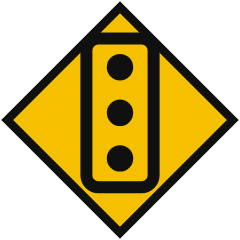
27. Why would this sign be installed on an approach?
Show answer
Answer B: Because the signal cannot be seen from far enough back for a driver to react in time
Advance notice of a signal is used where a crest, a curve, trees or a building keep the signal heads out of view until a driver is already too close to stop comfortably.
-
28. Your vehicle leaves the road and enters deep water. What gives you the best chance of escape?
Show answer
Answer B: Release your seat belt and get out through a window as quickly as possible
Water pressure holds the doors shut, so a window is the reliable exit and the first seconds after entry are the best time to use it.
-
29. You are approaching the crest of a hill and cannot see the road beyond it. What should you do?
Show answer
Answer C: Slow down and keep well to the right
Beyond a blind crest there may be a stopped vehicle, a cyclist or an oncoming driver crossing the center line, so reduce speed and hold your own side.
-
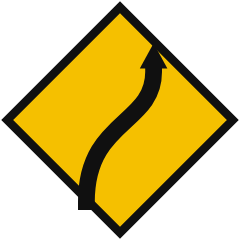
30. A driver holds a steady highway speed into the section this sign warns about. What is the most likely result?
Show answer
Answer B: The vehicle runs wide toward the outside and can cross into another lane or leave the pavement
Holding speed into a change of alignment asks the tires for more side grip than they can supply, so the vehicle runs wide and the driver is left with less room to correct.
-
31. A sign shows a lane joining from the right with no merge required. What does that mean?
Show answer
Answer B: The joining traffic gets its own new lane, so nobody has to merge
An added lane means the roadway gains a lane at that point, so entering vehicles have somewhere to go without anyone changing lanes.
-
32. An emergency vehicle is stopped on the shoulder ahead with its lights flashing. What does the move over principle require?
Show answer
Answer D: Change lanes away from it, or slow down if you cannot
Move over laws ask you to give responders an empty lane, and where traffic or a two-lane road makes that impossible, you slow down instead.
-
33. A school crossing guard steps into the roadway and holds up a stop paddle. What must you do?
Show answer
Answer D: Stop and stay stopped until the guard and the children have left the road
A crossing guard directs traffic with legal authority; you must remain stopped until both the guard and the children are clear of the roadway.
-
34. A marked accessible space is signed as van accessible. What is different about it?
Show answer
Answer B: It has a wider aisle for a ramp or a lift to come out
The extra width beside the space is there so a side ramp or lift can deploy and a wheelchair can get clear of the vehicle.
-
35. You are leaving a freeway on an exit ramp posted with an advisory speed of 25 mph. Where should you slow to that speed?
Show answer
Answer A: In the deceleration lane, before you reach the curve of the ramp
Slowing belongs in the deceleration lane so you arrive at the curve already at the advisory speed and do not hold up traffic still in the through lanes.
-
36. How is a third Florida DUI conviction classified when it occurs within 10 years of a prior conviction?
Show answer
Answer D: A felony of the third degree
A third DUI within 10 years after a prior conviction is a third-degree felony with an ignition interlock for at least 2 years.
-
37. A bus stopped at the corner hides the crosswalk you are about to turn across. What should you do?
Show answer
Answer C: Turn slowly, ready to stop for anyone stepping out in front of it
People often step into the road from in front of a stopped bus, so approach the hidden crosswalk slowly and be ready to stop.
-
38. On loose gravel or deep fresh snow, how does an antilock system affect the stopping distance?
Show answer
Answer D: It can lengthen it, although you keep the ability to steer
On loose surfaces a locked wheel piles up a wedge of gravel or snow that helps it stop, so the antilock stop can be longer even though steering still works.
-
39. A black on white regulatory sign at an intersection reads NO TURNS. What may a driver do there?
Show answer
Answer B: Only continue straight through the intersection
The NO TURNS sign bans turns in every direction at that intersection, so the only lawful movement from that approach is straight through.
-
40. How long does a DUI conviction remain on a Florida driving record?
Show answer
Answer A: 75 years
Florida keeps a DUI conviction on the driving record for 75 years.
-
41. A bicyclist in the bike lane ahead of you signals and starts to move left toward the turn lane. What should you do?
Show answer
Answer A: Slow down and let the rider move across
A bicyclist who needs to leave the bike lane to turn left is changing lanes like any driver, and following traffic should make room.
-
42. You come back to find that your parked car has rolled out into the street. What most likely went wrong?
Show answer
Answer C: The parking brake was not set and the wheels were not turned
The parking brake, a gear or park, and turned front wheels are three separate safeguards, and a runaway means at least the first two were missing.
-
43. The center line beside your lane is solid yellow while the opposite side has a broken yellow line. What does this mean?
Show answer
Answer D: You may not pass, but traffic in the other direction may
A solid yellow line on your side of the center marks a no-passing zone for your direction only, while the broken line grants the opposing direction a passing zone.
-
44. You are about to descend a long steep grade. How should you control your speed?
Show answer
Answer D: Select a lower gear before starting down and use the brakes in firm, brief applications
Engine braking in a lower gear carries most of the load down the grade, while continuous brake pressure overheats the brakes and reduces their effectiveness.
-
45. What is lane splitting?
Show answer
Answer B: A motorcycle riding between two lanes of traffic moving the same way
Lane splitting means riding along the line between two lanes of traffic going in the same direction rather than staying within a lane.
-
46. A yellow horizontal rectangular sign showing one large arrow pointing left or right, facing traffic on the far side of a sharp bend, tells the driver
Show answer
Answer C: which way the roadway turns at that point
The large arrow sign is mounted on the outside of a sharp change in alignment so that a driver approaching head on immediately sees which way the road goes.
-
47. Cones and drums mark a shifted lane through a work zone. What should you do?
Show answer
Answer A: Follow the path that they mark and stay inside it
Channelizing devices define the temporary travel path, and the space on the other side of them belongs to the workers.
-
48. Why does a dirty windshield matter much more at night than during the day?
Show answer
Answer C: Dust and streaks scatter oncoming light and increase glare
Film and streaks on the glass spread every oncoming headlight into a star of glare, so clean the inside as well as the outside before a night trip.
-
49. You are entering a marked work zone. What should you expect?
Show answer
Answer B: A reduced posted speed, narrowed or shifted lanes, and traffic that may stop suddenly
Work zones change the geometry of the road and can bring traffic to a halt without warning, so the posted work zone speed and increased following distance both apply.
-
50. A fire truck with lights and siren has just passed you and is heading down the same road. How closely may you follow it?
Show answer
Answer B: Well back, because following a responding emergency vehicle closely is illegal
Following a responding emergency vehicle closely is prohibited; the exact minimum distance is set by each state, so stay far enough back to keep the scene and other responders clear.